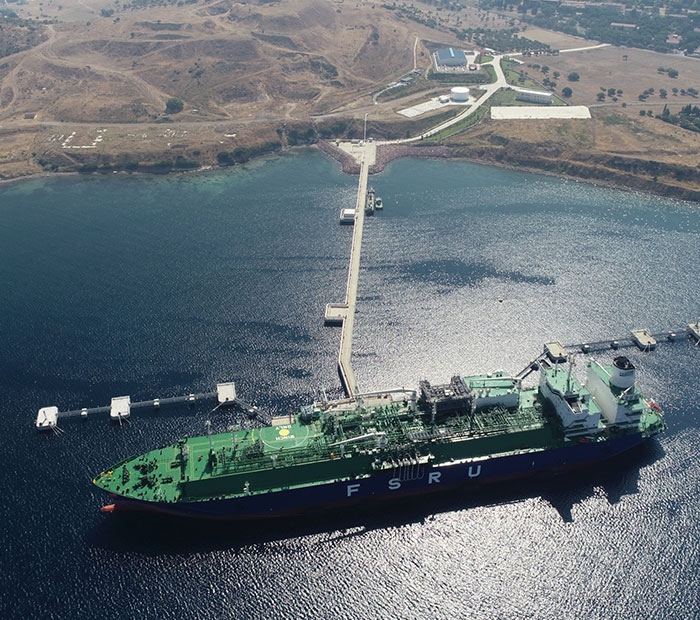
The 2019 built FSRU ‘Turquoise P’, owned by Pardus Energy Ltd., is stationed at the Etki Liman LNG terminal in the Turkish Aegean Sea, near Izmir. It has a length of 294 m and a cargo capacity of 170,000 cbm.

“This is a milestone for Pronav and the entire Schulte Group. We are proud that our many years of expertise in ship management of LNG carriers and our flawless safety record have enabled us to take on the technical management of ‘Turquoise P’,” says Martin Roolvink, Managing Director of Pronav. He emphasises that the LNG segment is subject to the most demanding industry requirements and that the highest safety and quality standards are key in LNG ship management.

FSRUs are ship-based facilities that receive, store, and convert liquefied natural gas back into gaseous natural gas for delivery to shore. The Etki Liman LNG terminal, connected to Türkiye’s national gas grid, is of major importance in supplying energy to the Izmir region, especially during times of peak demand or seasonal fluctuations. The unconditional availability and reliability of the facility is therefore a top priority.

There are currently just over 50 FSRUs in operation worldwide and only very few are managed by third-party ship managers. Pronav is highly recognised by energy majors, LNG charterers and LNG terminals around the world for its operational safety, quality, reliability, and efficiency. Pronav has more than 25 years’ experience in the technical management and crewing of different types of LNG carriers, such as the latest generation equipped with dual-fuel engines (MEGI & X-DF) but also slow-speed diesel with 100% relic plants (Q-Flex) as well as conventional steam vessels (both with Moss-type and membrane tanks).

‘Turquoise P’ is part of the Etki Liman LNG terminal in the Turkish Aegean Sea

Three questions to …

“Anything less than 100% reliability is simply not acceptable”

Drazen Predovan, Marine Operations Manager at Pronav, answers three questions about the special features and challenges involved in FSRU operations.

  • What is the main technical difference between a sailing LNG carrier and FSRU?

    A Floating Storage Regasification Unit is, first and foremost, a Liquefied Natural Gas Carrier. However, what sets it apart is its additional capability to convert LNG into Natural Gas and deliver it ashore at high pressure and temperature.

    This LNG-to-NG conversion capability introduces a higher level of design complexity compared to a conventional LNG Carrier. The most visible difference between an LNG Carrier and an FSRU is the regasification plant – a relatively large module that is depending on the FSRU design installed either near the compressor and electric motor room or forward, above cargo tank no. 1 and forecastle deck.

    What’s not visible from the outside are the numerous auxiliary systems onboard that support and enable the operation of the regasification plant. These include complex cargo heating and internal transfer systems, NG measurement and transfer systems, ship-to-ship transfer systems, and more. A high level of automation is also integrated to manage these systems, adding to the vessel’s operational complexity beyond that of a standard LNG Carrier.

    Operating and maintaining these additional systems requires specialized expertise. Perhaps the most significant operational difference is the need to perform multiple operations simultaneously – commonly referred to as SIMOPS – Simultaneous Operations.

    When an FSRU is “on station and in operation”, it becomes a carefully choreographed sequence of concurrent activities. These can range from relatively simple operations such as simultaneous internal cargo transfers, ballast operations, regasifying LNG and sending NG ashore, to highly complex scenarios involving the mooring of an LNG Carrier, hose connection, cargo loading on one manifold side while simultaneously conducting ballast operations, regasifying LNG, and sending NG discharge ashore on the opposite manifold side.
  • What is the biggest challenge in the operational FSRU management?

    Probably coordination, planning and assurance of uninterrupted service. This comes on top of the challenges related to managing a technically highly complex vessel from all aspects of ship management.

    As an integral part of the terminal and the broader energy supply chain, the majority of vessel activities must be carefully synchronized with multiple stakeholders to ensure safe and seamless operations. This includes both routine and ad-hoc maintenance, which often requires months of advance planning. Such activities must be planned and executed in a way to avoid any disruption to the vessel’s continuous operations.

    The need for reliability and uninterrupted service becomes even more pronounced in regions where the FSRU “on station” serves as a vital energy lifeline for local populations and industries. In such cases, any interruption in service can have significant consequences. Therefore, anything less than 100% reliability is simply not acceptable.

  • Has Pronav further capacities to increase the number of FSRUs in management?

    Bringing an FSRU into our management has been a challenging step for us as Pronav and for BSM as a whole. We always strive for operational excellence, and such dedication has enabled us to become a proud member of the very exclusive group of FSRU technical managers. In line with our long-term strategy, we want to further grow our managed fleet of LNG Carriers and also increase our footprint in the highly specialized FSRU sector. We continuously improve our procedures and develop our personnel resources, which is why we are ready to welcome further FSRUs into our management.

Martin Roolvink

Managing Director Pronav

Contact
DO YOU HAVE QUESTIONS?

E-mail the expert.

RELATED BSM Highlights

Lost in signal: The challenge of GNSS disruptions

Satellite navigation has become an integral part of everyday life, supporting everything from mobile mapping to secure banking. While these systems are generally dependable, incidents of signal interference and manipulation are on the rise. If a misplaced navigation dot is an annoyance on land, the same failure at sea can quickly become a frontline operational challenge, testing not only the resilience of a ship’s systems, but also the capabilities of its crew.

Empowering seafarers for a multi-fuel future

As the maritime industry navigates its course toward lower emissions, a range of alternative fuels is reshaping how ships are powered. But the shift to new fuels is more than a technical change — it is a human one. Ensuring that seafarers are properly trained to handle, operate, and manage alternatively powered vessels is key to securing a smooth transition to the fuels of the future. Bernhard Schulte Shipmanagement prepares its crew to power tomorrow’s ships through comprehensive training programmes.

Is seafaring still attractive?

Since the steam engine era, society has progressed through the technological and digital revolutions. Today, Industry 4.0 offers near-limitless access to knowledge and a vast network of connected devices. Products or services seem only one click away. But as long as sci-fi ‘beaming’ technology remains fiction, maritime transport will continue to carry most goods, keeping seafarers at the heart of global trade. But is seafaring still attractive?