One participant close to us described the plenary proceedings as “unprecedented” and “at times tumultuous”. It wasn’t just about the mechanics of the proposal — politics played a significant role, to say the least. In the end, a motion to postpone the finalisation of the IMO NZF by one year carried the day.

Where does this leave us?

Together with our principals, the ship owners, we ship managers had hoped for a single, globally applicable ruleset to meet the strategic objectives of the 2023 IMO GHG Strategy — one that could be implemented smoothly and with minimal administrative burden.

Ship owners require clear and predictable rules to guide their investment decisions. Likewise, ship managers should not be burdened with administering a patchwork of regional regulations that aim for the same goal yet remain unaligned — each with differing definitions, timelines, mechanisms, and, too often, overlapping levies without coordination or an overall cap. This situation benefits no one.

One participant close to us described the plenary proceedings as “unprecedented” and “at times tumultuous.” It wasn’t just about the mechanics of the proposal — politics played a significant role, to say the least. In the end, a motion to postpone the finalisation of the IMO NZF by one year carried the day.

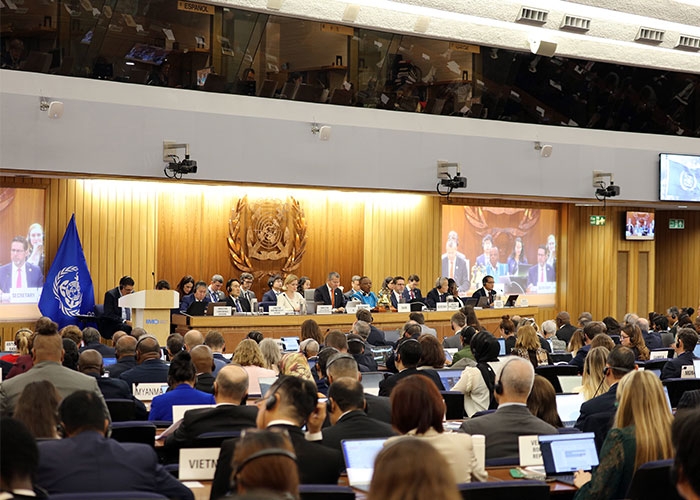
Opening of the IMO Marine Environment Protection Committee (MEPC) 2nd extraordinary session, 14-17 October 2025 © International Maritime Organization
The good, the bad — and the opportunity

On one hand, the outcome in London is disappointing. It prolongs uncertainty for ship owners ready to order new vessels but waiting for regulatory clarity. Meanwhile, ship managers must continue navigating multiple regional rules — with the risk of even more proliferating.

On the other hand, the pause presents an opportunity to refine the proposal. The industry needs a clearer definition of the future IMO compliance framework, particularly given that the NZF would channel substantial financial flows through the IMO. Such financial responsibility demands robust foundations.

Importantly, several industry requests were heard — particularly from certain EU IMO member states — and can now hopefully be debated and addressed constructively. Key points include the role of LNG, appropriate timelines and thresholds, and ensuring that funds generated under the NZF to a certain extend flow back into supporting investment in alternative-fuel technologies and infrastructure.

From the perspective of a ship manager, we can only hope that this extra time leads to meaningful improvement — and ultimately to a framework that is fair, practical, and effective in guiding shipping’s decarbonisation journey. The rest as they say will then be “politics”.
RELATED BSM Highlights

Lost in signal: The challenge of GNSS disruptions

Satellite navigation has become an integral part of everyday life, supporting everything from mobile mapping to secure banking. While these systems are generally dependable, incidents of signal interference and manipulation are on the rise. If a misplaced navigation dot is an annoyance on land, the same failure at sea can quickly become a frontline operational challenge, testing not only the resilience of a ship’s systems, but also the capabilities of its crew.

Empowering seafarers for a multi-fuel future

As the maritime industry navigates its course toward lower emissions, a range of alternative fuels is reshaping how ships are powered. But the shift to new fuels is more than a technical change — it is a human one. Ensuring that seafarers are properly trained to handle, operate, and manage alternatively powered vessels is key to securing a smooth transition to the fuels of the future. Bernhard Schulte Shipmanagement prepares its crew to power tomorrow’s ships through comprehensive training programmes.

Is seafaring still attractive?

Since the steam engine era, society has progressed through the technological and digital revolutions. Today, Industry 4.0 offers near-limitless access to knowledge and a vast network of connected devices. Products or services seem only one click away. But as long as sci-fi ‘beaming’ technology remains fiction, maritime transport will continue to carry most goods, keeping seafarers at the heart of global trade. But is seafaring still attractive?